Guide
What Norristown's Ordinance 21-14 Actually Requires: A Landlord's Guide to Chapter 200
Ordinance 21-14 codified Chapter 200 in 2021. Here's exactly what it requires - the four triggers, the three-year cycle, who can inspect, and why the real penalty is license denial, not a lead fine - cited to the ordinance's own text.
Published August 16, 2026 · Norristown, PA
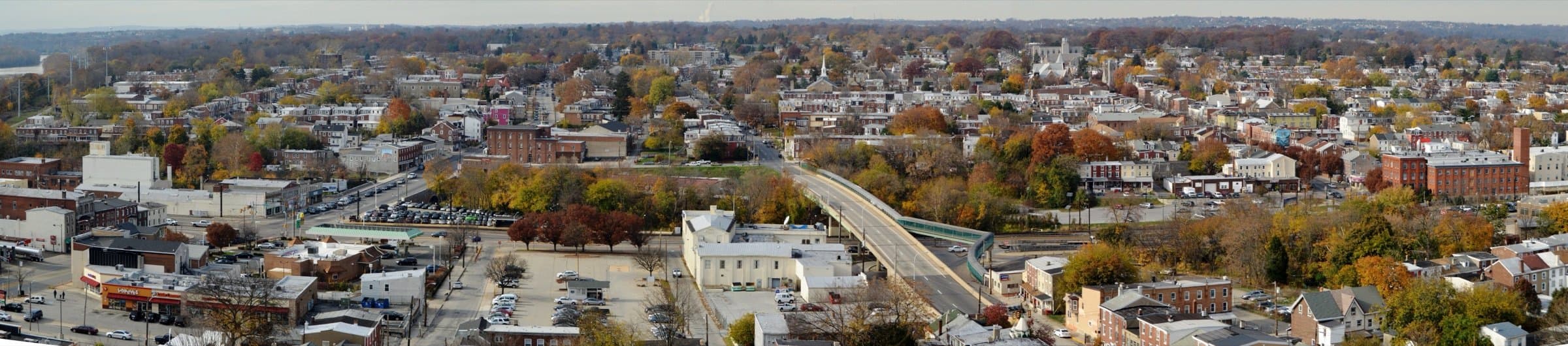 Photo: Montgomery County Planning Commission, CC BY-SA 2.0
Norristown enacted Ordinance 21-14 on November 16, 2021, codifying it as Chapter 200 of the municipal code, “Lead Poisoning Prevention and Lead Hazard Control.” In practical terms it works as a gate: the Municipality will not issue or renew a rental license for a covered pre-1978 property until it has a current Lead-Safe or Lead-Free report on file. This guide walks through what Chapter 200 actually says, trigger by trigger, cited to the ordinance's own codified text rather than the summaries that circulate online.
Source: Norristown Ordinance 21-14, Chapter 200 (executed original) (2021)
One correction worth making up front: the ordinance took effect on approval. Its own effective clause reads, “This Ordinance shall take effect and be in force from and after its approval as required by the law” – approved November 16, 2021. A “January 1, 2022” compliance-start date is repeated in some secondary sources, but that date appears nowhere in the ordinance's text, so we do not treat it as operative.
Source: Norristown Ordinance 21-14, effective clause (2021)
What Chapter 200 is for, and the four things that trigger it
The chapter states its own purpose in §200-1:
“The purpose of this Chapter is to protect and promote the public health, safety and welfare through the identification and elimination of lead source hazards in the built environment.”
Section 200-3 then lists four separate triggers, each of which independently requires a lead paint inspection and report. A property does not have to hit all four – any one of them applies on its own:
- Rental licensing (§200-3.A). “The Municipality shall not issue a rental registration license or renewal thereof unless the Municipality has received a Lead (paint) Safe Report or Lead (paint) Free Report when required.”
- Condemned property (§200-3.B). “For Structures that are a Condemned Property, said lead paint inspection shall be performed within six months of and the corresponding report shall be submitted prior to authorizing and/or removing any condemnation placard.”
- Daycare (§200-3.C). A report is due “prior to the issuance of the next required certificate of occupancy.”
- Property transfer (§200-3.D). A report is required “as part of the real estate transfer inspection process.”
Source: Norristown Code §200-1, §200-3 (2021)
The condemned-property trigger is the one most easily missed. It is not tied to a rental license or a sale – it attaches to the condemnation placard itself, and the report has to be submitted before that placard can be authorized or removed. If you are bringing a condemned Norristown structure back into use, the lead inspection is part of clearing the condemnation, not a step you get to defer.
The three-year cycle, and the lead-free exception
For rentals, the requirement recurs. Section 200-3.A sets a three-year cycle keyed to the license submission:
“a new lead paint inspection with corresponding report shall be required with the submission of a rental license and/or registration every three years (ex. Initial Submission in 2021, subsequent submission due 2024).”
There is one way off that treadmill. A Lead-Free report – the stronger finding that no lead-based paint is present at all – is permanent: “If a Lead (paint) Free Report is submitted… then no further lead paint based inspections or reports shall be required.” A Lead-Safe report, by contrast, certifies that the property currently poses no lead hazard and has to be renewed on the three-year cycle. The distinction between the two matters enough that we cover it in its own guide: lead-safe vs. lead-free certification in Pennsylvania.
Source: Norristown Code §200-3.A (2021)
Who is allowed to perform the inspection
Chapter 200 does not let just anyone sign a report. Section 200-2 defines the two eligible roles, and both are federally and state credentialed. A Certified Lead-Based-Paint Risk Assessor must “maintain a current certification from the Environmental Protection Agency (EPA) and” be “licensed by the Commonwealth of Pennsylvania.” A Certified Lead Dust Sampling Technician must be certified by the EPA or the Commonwealth to perform clearance testing under EPA's Renovation, Repair, and Painting (RRP) Rule and must work for a Licensed Lead RRP Company. In short: the person who inspects your Norristown property needs a real EPA credential and a Pennsylvania license behind it.
Source: Norristown Code §200-2 (2021)
What it costs, and the penalty that is not a lead fine
The Municipality charges no lead-certification fee of its own. Chapter 200's only fee reference is an appeal fee, set by separate resolution rather than named in the ordinance, and the 2026 fee schedule carries no lead-cert line item. The costs a Norristown landlord actually pays are the private inspection and the standard rental-license or use-and-occupancy fee – roughly $75 per unit – neither of which is lead-specific.
Source: Municipality of Norristown fee schedule (2026)
There is no lead-specific fine in Chapter 200 - the penalty is a license you cannot get
This is the subtlety worth stating plainly: Chapter 200 has no dedicated penalty section. Non-compliance is not enforced by a lead-paint fine. It is enforced at the gate – no Lead-Safe or Lead-Free report means no rental license and no renewal under §200-3.A, and at transfer only a temporary certificate of occupancy is available under §200-3.D. The financial exposure comes from the adjacent code chapters a non-compliant, therefore unlicensed, landlord would actually hit:
- §109.4.1, Building Safety / Property Maintenance Code: $300–$1,000 fine or up to 30 days imprisonment, with each day a separate offense.
- §245-4, rental-licensing chapter: $300–$1,000 per unlicensed unit, each day a separate offense.
- §802.1.2: occupying a unit before it is licensed is a flat $300 per day.
So the honest way to describe the risk is not “a lead fine” but “you cannot legally license or occupy the unit, and every day you do it anyway is a separately finable code violation.”
Source: Norristown Code §109.4.1, §245-4, §802.1.2 (2021)
A genuine two-chapter overlap worth knowing about
If you go looking for Norristown's rental-licensing rules, you will find them in two places, and that is not a mistake in the code. An older Chapter 245, “Rental Property” (last amended in the 2012–2015 range), still exists alongside the newer, more detailed Chapter 239A, §§801–805, “Rental License,” adopted in 2021 as part of the full property-maintenance recodification. Norristown's own rental-license affirmation form cites both. Treat Chapter 239A §802 as the operative framework and Chapter 245 as a legacy cross-reference rather than assuming one supersedes the other outright – the $300-per-day occupancy penalty above lives in that newer chapter.
Source: Norristown Code Chapter 239A §§801–805; Chapter 245 (2021)
How you actually file the certificate
Norristown routes lead certificates to a dedicated intake address, LeadCert@Norristown.org, and the Rental Registration Application carries a “Lead Safe / Lead Free Certificate on File?” checkbox directly on the form, so the certification is checked as part of the ordinary license workflow rather than as a separate submission. The Lead-Safe certification template itself is embedded in the borough's Use & Occupancy packet.
Source: Municipality of Norristown, Rental Registration Application (2024)
Source: Municipality of Norristown, Use & Occupancy / Property Transfer packet (2026)
The borough does not publish a standalone landlord-facing lead FAQ; the general forms-and-permits page is the practical starting point for the underlying rental and transfer applications the lead report attaches to.
Source: Municipality of Norristown, Forms and Permits (2026)
Is it actually enforced? The independent evidence
For a small-borough ordinance, Norristown's is unusually well-enforced, and the evidence is not just the borough's own say-so. An October 2023 municipal announcement reported more than 4,350 housing units certified as lead-free or lead-safe, with at least 50% of rental units meeting the standard – a real, rising compliance number rather than an ordinance on paper.
Source: Municipality of Norristown lead program announcement, October 2023 (reported by Patch) (2023)
The program also earned national recognition: Norristown won the 2024 HUD Secretary's Award for Excellence in Healthy Homes specifically for this lead work, coverage of which ran in the ICC Building Safety Journal. An award at that level implies audited, verifiable progress, not a self-reported figure.
Source: 2024 HUD Secretary's Award for Excellence in Healthy Homes, U.S. Dept. of Housing and Urban Development (2024)
Stated plainly: the most recent compliance figures are secondary-source estimates
By roughly mid-2024, secondary sources put Norristown's compliance above 60% and more than 5,000 units. We report those numbers as secondary-source estimates, not primary-verified figures – the confirmed, primary-source-anchored trend is the 2023 announcement above.
We were also unable to independently verify current-year (2025–2026) council-level enforcement detail in this pass: Norristown's public agenda calendar is a JavaScript-rendered system that our review could not pull live minutes from. The historical trend through 2023–2024 is solid; the most recent year is a documented blind spot we are not going to paper over.
The real scope, from our own dataset
Everything above is about the law. This is about how many properties it reaches. We track all 8,204 pre-1978 Norristown properties – the ones old enough to fall within Chapter 200's scope when they are rented, sold, condemned, or used as a daycare – built from Montgomery County's public parcel assessment roll. That is a current-as-of-ingestion count of the covered universe, aggregated from the county's own records rather than estimated from the ordinance text.
Source: Keystone Lead Certified tracking database, built from Montgomery County's public parcel assessment roll (via PASDA) (2026)
One Lead-Safe or Lead-Free report, filed with the borough for you.
We test, the lab verifies, and we file it to LeadCert@Norristown.org so your rental license clears the Chapter 200 gate.
Book Norristown certification